
Every photograph is a two-dimensional surface, but the best ones create the illusion of depth. They pull you in, take your eye on a journey, and deposit you exactly where the photographer wanted you to land. The most reliable tool for creating that journey? Leading lines.
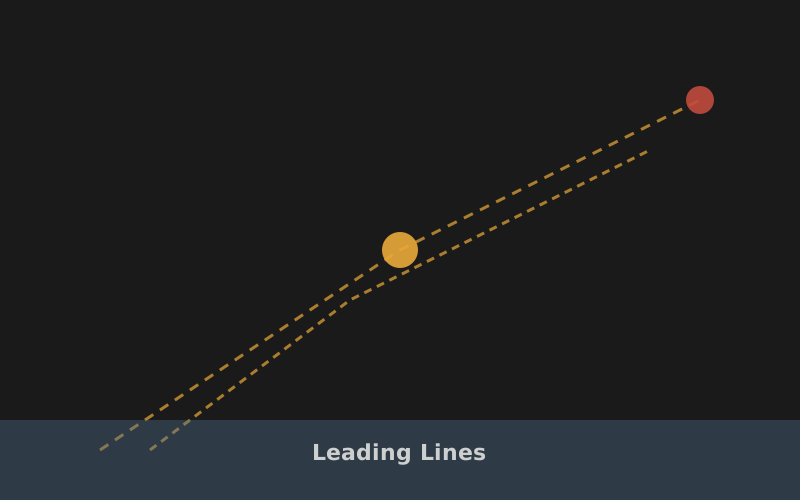
Leading lines are exactly what they sound like: lines within your scene that lead the viewer's eye from one point to another. They're one of the most powerful compositional devices because they don't just suggest where to look — they physically direct the eye along a path. You're not hoping the viewer notices your subject. You're building a road straight to it.
Why Leading Lines Work So Well
The human visual system is wired to follow lines. It's a survival instinct — lines suggest edges, paths, boundaries, and movement. When we see a line in an image, our eye can't help but trace it. This isn't a learned behavior; it's how vision works.
Photographers exploit this instinct. By positioning yourself so that natural lines in the scene point toward your subject, you harness the viewer's own perceptual machinery to do your compositional work. The eye follows the line not because it wants to, but because it has to.
Leading lines also solve photography's central problem: flattening a three-dimensional world into two dimensions. Lines that recede into the distance create perspective, giving a flat image a sense of depth and dimensionality. A road stretching toward a distant mountain doesn't just lead the eye — it tells the viewer that the mountain is far away, creating spatial understanding.
Where to Find Leading Lines
Lines are everywhere once you start looking for them. The trick is training your eye to see them before you raise the camera. Here are the most common and effective sources:
- Roads and pathways: The classic. A road, trail, or sidewalk receding into the distance is the most natural leading line available. Curved paths are especially effective because they create a sense of journey and mystery — the eye wants to follow the curve to see where it goes.
- Rivers and coastlines: Water features create natural lines that wind through landscapes. A riverbank, a shoreline, or a stream all serve the same function as a road, but with added organic texture.
- Architecture: Buildings are full of lines — rooflines, columns, fences, bridges, staircases. Architectural lines tend to be straight and geometric, which creates a different emotional feel than organic lines like rivers.
- Shadows: Shadow edges are lines, and they're often more interesting than physical lines because they're temporary and atmospheric. A long shadow cast by a tree or building at golden hour can lead the eye dramatically.
- Natural features: Tree lines, rock formations, mountain ridges, rows of crops — the natural world is full of linear elements if you look for them.
- Human-made patterns: Railway tracks, fence posts, power lines, boardwalks, pier railings. Any repeating linear structure works.
Training Exercise
Go for a 15-minute walk without your camera. Your only goal: spot leading lines. Count how many you find. You'll be surprised how many you've been walking past without noticing.
Types of Leading Lines and Their Effects
Not all leading lines do the same thing. The type of line you use changes the emotional quality of the image.
Converging Lines
When two or more lines come together at a point — like railway tracks meeting at the horizon, or the walls of a hallway narrowing toward a doorway — they create an especially powerful pull. The convergence point becomes a natural focal point, and placing your subject there makes the lines feel like they're funneling directly toward it. This is called one-point perspective, and it's one of the strongest depth cues in photography.
Diagonal Lines
Diagonals create energy and dynamism. Unlike horizontal lines (which feel stable and calm) or vertical lines (which feel formal and imposing), diagonals feel active and slightly unsettling — in a good way. A diagonal leading line suggests movement, tension, and progression. Composing your subject where a diagonal meets an edge of the frame creates a particularly dynamic image.
Curved Lines
Curves — especially S-curves — create a sense of grace and flow. A winding road through a valley, a meandering river, a curved staircase. Curves slow the eye down, making the visual journey feel leisurely rather than direct. They're excellent for landscapes where you want to convey beauty and tranquility rather than energy.
Implied Lines
Not all lines are physical. An implied line is created by a sequence of elements — a row of streetlamps, a line of people, a series of rocks stepping across a stream. The eye connects them into a line even though no continuous line exists. Implied lines are subtler and often more sophisticated than explicit ones.
A line doesn't have to be drawn. It just has to be followed.
Where Leading Lines Should Go
Knowing where to find lines is half the battle. The other half is knowing where to point them. Here are the three most effective destinations:
To your main subject. This is the classic use. Position yourself so the line originates at the edge of the frame and travels inward to your subject. The line says "look here." This works for everything from portraits (a pathway leading to a person) to landscapes (a river leading to a mountain peak).
Into the distance (vanishing point). Sometimes there's no single subject — the line itself is the subject, and the vanishing point where it disappears creates a sense of depth and mystery. This is common in road photography, tunnel shots, and minimalist landscapes.
Out of the frame. Lines that exit the frame create a different effect — they suggest that the story continues beyond what the viewer can see. This can create intrigue or restlessness, depending on the context. Use it deliberately when you want the viewer to wonder what's beyond the edge.
Combining Leading Lines with Other Composition Tools
Leading lines rarely work in isolation. The strongest compositions combine them with other techniques. For instance, a leading line that arrives at a subject placed on a rule of thirds intersection gives you a double reinforcement: the line directs the eye, and the placement holds it there.
Similarly, leading lines pair powerfully with frame-within-a-frame techniques. A line that passes through a natural frame (an archway, a gap between trees) and continues to your subject creates a layered composition with tremendous depth.
Common Mistakes to Avoid
Lines that lead nowhere. If your leading line points to empty space or a visually uninteresting part of the frame, it actively works against you. The eye follows the line, finds nothing, and feels disappointed. Always check where the line is taking the viewer.
Competing lines. Too many lines going in different directions creates visual chaos. If your scene has multiple strong lines, try to find an angle where most of them converge or at least run roughly parallel. One or two clear lines are stronger than five confusing ones.
Lines that lead out of the frame. Unless this is intentional, lines that exit the frame pull the viewer's eye out of the photo entirely. Reposition yourself so the line curves back into the frame, or use another element to block the exit point.
Forgetting about the subject. It's easy to get so excited about finding a great leading line that you forget to check whether the subject at the end of it is actually interesting. A perfect line leading to a boring subject is still a boring photo.
Putting It Into Practice
Here's your assignment: find three different types of leading lines this week — one road or path, one architectural element, and one natural feature. For each, shoot two versions: one where the line leads to a clear subject, and one where the line leads to a vanishing point. Compare the results. You'll start to feel how lines change the emotional register of an image, and that feeling will become part of your compositional instinct.
Leading lines are not a trick. They're a fundamental way that humans perceive space and direction. Once you learn to see them, you'll find them everywhere — and your photos will have a depth and intentionality that pure subject-placement can't achieve alone.
Key Takeaways
- Leading lines exploit the eye's natural tendency to follow lines, directing attention with force.
- Lines are everywhere — roads, rivers, architecture, shadows, natural features, and patterns.
- Different line types create different moods: diagonals add energy, curves add grace, converging lines add depth.
- Always check where the line is leading — it should arrive at your subject or a meaningful vanishing point.
- Combine leading lines with the rule of thirds and framing for layered compositions.
Keep Composing
Leading lines are one of many composition tools. Explore the full set in our composition guide hub.
Browse Composition Guides