
Every photographer faces this decision eventually: prime or zoom? It's presented as a simple either/or, but the honest answer is more interesting than any spec sheet comparison. The right question isn't "which is better?" — it's "which makes you better?"
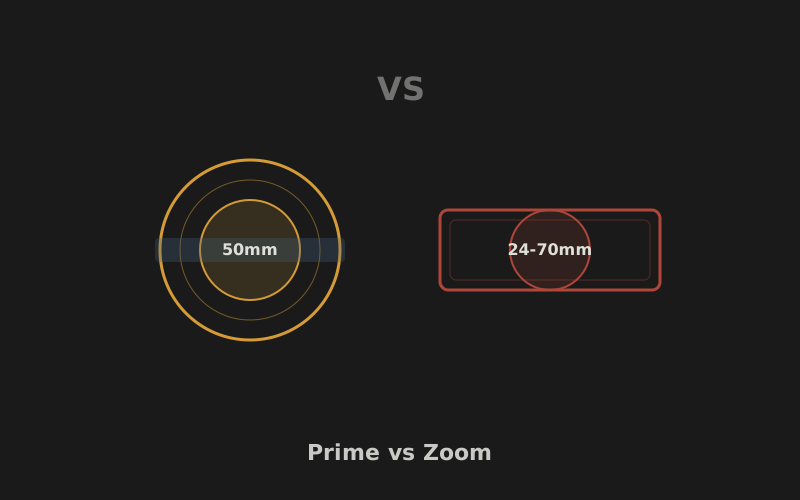
I've shot extensively with both. I've owned $2,000 zooms and $150 primes. I've taken terrible photos with both and great photos with both. What I've learned is that the prime-vs-zoom debate isn't really about optical quality or convenience — it's about how each type of lens changes the way you see, and therefore the way you shoot.
Let's break down what each lens actually does, what it's good at, and — most importantly — how each one shapes your development as a photographer.
The Definitions
A prime lens has a fixed focal length. A 50mm prime is always 50mm. To make your subject bigger or smaller in the frame, you physically move — walk closer, step back. The focal length is fixed; your feet do the zooming.
A zoom lens has a variable focal length. A 24-70mm zoom can be any focal length in that range. You change magnification by turning a ring on the lens, without moving your feet.
That distinction — moving your feet versus turning a ring — sounds minor. It's not. It changes everything about how you interact with your subject and your environment.
The Case for Primes
Wider Maximum Apertures
This is the most cited advantage of primes, and it's real. A 50mm f/1.8 prime (often under $200) opens to f/1.8, while most zooms max out at f/2.8 or f/4. That wider aperture means two things: more light gathering (useful in low light) and shallower depth of field (blurrier backgrounds for portraits).
If you love the creamy-background portrait look or you shoot in dim conditions without a flash, primes give you capabilities that zooms simply can't match at any reasonable price. An f/1.4 prime gathers sixteen times more light than an f/4 zoom. That's the difference between shooting at ISO 400 and ISO 6400.
Forced Movement Builds Compositional Skill
Here's the advantage that spec sheets can't measure. When you shoot with a prime, you can't zoom. To reframe, you have to move. This sounds like a limitation, but it's actually a forcing function for better composition.
With a zoom, when something doesn't look right in the frame, you turn the ring. The composition changes, but your relationship to the scene doesn't. With a prime, when something doesn't look right, you walk. You explore angles. You discover perspectives you wouldn't have found if you'd just zoomed from where you stood. You become an active participant in the composition rather than a passive observer.
This movement — the physical exploration of a scene — is the single biggest reason experienced photographers often recommend primes to beginners. It builds the habit of working a scene rather than settling for the first acceptable framing.
A zoom lens helps you find the right framing from where you're standing. A prime forces you to find the right place to stand.
Lower Cost and Weight
Primes are simpler — fewer optical elements, no zoom mechanism — so they're typically cheaper, lighter, and smaller than equivalent-quality zooms. A nifty fifty (50mm f/1.8) costs $150-250 and weighs a few ounces. A professional 24-70mm f/2.8 zoom costs $2,000+ and weighs over two pounds. For the price of one pro zoom, you could own three or four primes.
Optical Quality
Primes are generally sharper than zooms at the same price point, especially at the edges of the frame. This is because they're optimized for a single focal length, while zooms must compromise across a range. That said, modern high-end zooms are excellent — the sharpness gap between a pro zoom and a prime is often imperceptible in real-world use. Don't let sharpness be your deciding factor unless you're making very large prints.
The Case for Zooms
Versatility and Convenience
This is the zoom's killer feature, and it's more valuable than prime enthusiasts often admit. A single 24-70mm zoom covers the focal lengths of at least three primes (24mm, 35mm, 50mm). You don't need to change lenses, which means you capture shots you'd otherwise miss and you keep dust off your sensor.
For travel, events, and documentary work where conditions change rapidly and you can't always reposition, a zoom's flexibility is genuinely transformative. A wedding photographer who needs to go from a wide establishing shot to a tight portrait in two seconds can't swap lenses. A travel photographer on a moving boat can't walk closer to a distant subject.
Consistent Maximum Aperture
Professional zooms (the f/2.8 models) maintain the same maximum aperture across their entire zoom range. An f/2.8 70-200mm gives you f/2.8 at 70mm and at 200mm. This matters because your exposure settings don't change when you zoom — you can set f/2.8 and 1/200s and know it'll stay consistent as you reframe. Cheaper variable-aperture zooms (f/3.5-5.6, for example) lose light as you zoom in, which can force exposure changes mid-shoot.
One Lens, Many Focal Lengths
If you're trying to learn what focal lengths you prefer, a zoom is an excellent discovery tool. Shoot a 24-70mm for a month, review your photos, and see which focal lengths you gravitate toward. That data is valuable — it might tell you that you're naturally a 35mm shooter, and then you can buy a fast 35mm prime knowing it'll suit you. A zoom teaches you your preferences; a prime then lets you specialize in them.
The Honest Comparison
Let's be direct about the trade-offs:
Choose primes if: you want maximum image quality per dollar, you shoot in low light, you love shallow depth of field, you're willing to move your feet, and you want to develop your compositional eye through constraint. Primes make you work harder, and that work makes you better.
Choose zooms if: you need flexibility across changing conditions, you shoot events or travel where lens changes are impractical, you're still discovering your preferred focal lengths, or you simply value convenience and don't want to think about which lens to bring. Zooms remove friction, and removing friction means you shoot more.
Choose both if: you can afford it. Many serious photographers carry a zoom for flexibility and a fast prime for low light and shallow depth of field. A 24-70mm f/2.8 zoom plus a 50mm f/1.4 prime covers nearly every situation with excellence.
The Beginner's Dilemma
If you're just starting out and can only buy one lens, here's my honest recommendation: get a 50mm f/1.8 prime (or 35mm if you shoot APS-C). It's cheap, it's fast, it forces you to move, and it will teach you more about composition in six months than any zoom will in two years. Once you understand how you see, then buy a zoom that fills your practical needs.
Which Actually Makes You Better?
Here's the question this article is really about. Not which lens is technically superior — which one will develop your skills faster?
For most hobbyists, the answer is a prime. Here's why: the constraint of a fixed focal length forces you to engage with composition, perspective, and movement in ways that zooms let you skip. When you can't zoom, you have to think about where you're standing and why. You have to decide if the subject is better close or far, and then physically commit to that decision. This builds an intuitive understanding of focal length that no amount of zoom-ring-turning can replicate.
That said, this assumes you're willing to move. A prime in the hands of a lazy photographer who won't walk is just a badly-framed photo. The prime doesn't make you better automatically — it creates the conditions for growth, but you have to do the growing.
Zooms make you better in a different way: they let you shoot more, in more situations, with less friction. If the barrier to your improvement is that you don't shoot enough — you're intimidated by gear complexity, you don't want to swap lenses, you miss shots while fumbling — then a zoom that removes those barriers will help you improve simply by letting you practice more. Practice is the ultimate teacher, and anything that gets you shooting more is worth its weight.
The lens that makes you better is the one that gets you shooting. For some that's the constraint of a prime; for others it's the freedom of a zoom. Know yourself.
The Focal Length Learning Path
If you decide to go the prime route, here's a learning path that builds skill progressively:
Start with 50mm (or 35mm on crop sensors). This focal length approximates the human eye's perspective. It's versatile enough for portraits, street, and documentary, and it's where most photographers find their natural seeing distance. Spend six months mastering one focal length before adding others.
Add a wide angle (24mm or 28mm) next. Wide angles teach you about foreground-background relationships, leading lines, and environmental storytelling. They're harder to use well because they include more in the frame, but they expand your compositional vocabulary.
Then a short telephoto (85mm). This is the portrait lens — it compresses perspective, flatters faces, and teaches you about isolation and subject emphasis. Pair what you learn about aperture and depth of field with this lens for portraits with beautiful background separation.
By the time you've worked through three primes, you'll understand focal lengths intuitively. You'll know which one to grab for a given scene without thinking. And you'll have developed compositional habits — movement, exploration, intentionality — that will make you a better photographer regardless of which lens is on your camera.
The Bottom Line
Primes and zooms aren't competitors. They're tools with different strengths, and mature photographers use both. The myth that "real photographers shoot primes" is as unhelpful as the myth that "zooms are for amateurs." The right lens is the one that fits your photography, your budget, and your personality.
If you're still developing your eye, try a prime. The constraint will teach you. If you're shooting in conditions that demand flexibility, use a zoom. The freedom will let you capture what a prime would miss. And if you're serious about photography, eventually you'll own both — because the question was never really "prime or zoom?" It was "what do I need to make the photos I want to make?"
Key Takeaways
- Primes offer wider apertures, lower cost, and force movement that builds compositional skill.
- Zooms offer versatility, consistent aperture, and the ability to shoot in rapidly changing conditions.
- Primes develop your eye through constraint; zooms develop it through volume of practice.
- For beginners, a 50mm f/1.8 prime is the best learning tool per dollar spent.
- The right lens is the one that fits your photography — eventually, you'll want both.
Build Your Gear Knowledge
Lenses are one part of the gear equation. Explore our full library of gear guides.
Browse Gear Guides